Choosing a China Top Aluminium Washroom Door Supplier requires more than comparing catalog prices. The real question is performance under daily pressure: humidity, disinfectant, impact, and repeated opening. Aluminium Washroom Door systems must resist corrosion while maintaining clean lines and reliable movement.
Grand View Research reports that the global aluminium doors market is expanding steadily, supported by commercial construction and demand for durable, low-maintenance products. Mordor Intelligence also identifies institutional and commercial buildings as important application areas. However, these reports rarely separate washroom doors from the wider aluminium door category. That limitation matters. Supplier claims should therefore be checked against alloy grades, coating specifications, hinge cycles, panel thickness, and documented project performance.
Design expert Charles Eames said, “The details are not the details. They make the design.” His observation fits washroom construction closely. A door may appear flawless in a showroom, yet fail when its bottom edge absorbs moisture or its hardware loosens after months of cleaning. In practice, experienced buyers inspect corner joints, concealed fixings, lock accessibility, and replacement procedures. Small details decide long-term value.
A credible Chinese supplier should provide test records, installation guidance, sample approval, and clear after-sales responsibilities. ISO 9001 certification can support process confidence, but it does not replace product-level inspection. That is an uncomfortable point. A polished website proves very little.
This guide evaluates suppliers through measurable criteria, practical experience, and transparent evidence. It also recognizes that no single door suits every project. A hotel, school, factory, and hospital need different specifications. The strongest choice balances hygiene, durability, appearance, lead time, and total lifecycle cost.
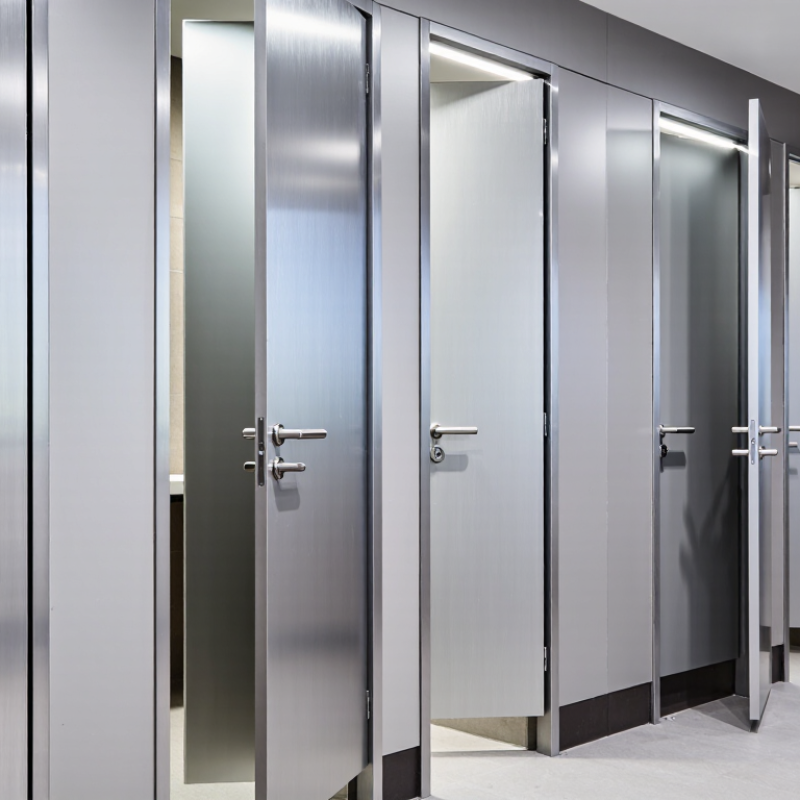
What Defines a Top Aluminium Washroom Door Supplier in China?
A top aluminium washroom door supplier in China is defined by more than low pricing. Practical experience shows that material control matters every day. Reliable suppliers use corrosion-resistant aluminium, stable profiles, and moisture-tolerant finishes. They should explain alloy options, hardware grades, and production limits clearly. Strong suppliers also provide accurate drawings, samples, and measured installation guidance. Their quality team checks frame dimensions, hinge alignment, surface coating, and door movement before shipment. Factory visits or live inspections can reveal more than polished catalog images.
Tips: Ask for aluminium thickness, coating details, hardware specifications, and test records. Request a physical sample before approving bulk production. Check how the supplier handles damaged goods, design changes, and delayed delivery. A clear answer is a useful quality signal.
Communication is another defining factor. Experienced teams confirm opening sizes, wall conditions, ventilation needs, and cleaning routines. They understand that a washroom door faces water, traffic, and frequent contact. Good suppliers adjust details without hiding extra costs. Still, perfection should not be assumed. Some samples look excellent, yet production consistency may weaken under pressure. Independent inspection can reduce this risk. Response speed also matters, but fast replies do not always prove technical ability. Look for careful questions, traceable records, and solutions that fit the building rather than copied specifications.
FAQS
The design should begin with site measurements, not a standard catalogue. Engineers should check cubicle width, ceiling height, humidity, traffic, and cleaning routines. They should then select suitable panels, hinges, locks, and edge profiles. A catalogue is not proof.
Aluminium is lightweight and resists corrosion in humid interiors. However, aluminium alone does not guarantee long service life. Weak fasteners, poor drainage, or thin panels can cause early problems. Material selection still needs careful review.
Reliable production may include CNC cutting, punching, bending, finishing, and controlled assembly. Each batch should follow approved drawings and traceable material records. Workers should check dimensions with calibrated tools. Small errors become visible later.
Request a physical sample whenever possible. Inspect corners, panel gaps, hinge alignment, and lock movement by hand. Ask for material records, coating details, tolerances, and inspection documents. A polished catalogue is not enough.
Testing should reflect repeated daily use. Useful checks include door-cycle tests, hardware pull tests, water exposure, and coating inspections. Project specifications may also require fire-related performance checks. Laboratory testing helps, but it cannot replace site supervision.
Powder coating provides consistent colour and a hard surface. Anodizing creates a metallic appearance and supports surface protection. Both finishes still need suitable cleaning methods. Ask about coating thickness and salt-spray results.
Stainless steel hinges, adjustable pivots, and moisture-resistant fasteners are practical choices. Hardware quality often determines whether a door remains aligned. Request hinge-cycle testing and replacement information. Replaceable parts matter.
Confirm the opening size, partition thickness, privacy clearance, and accessibility requirements. Review non-standard heights, louvered panels, vision gaps, concealed hardware, and colour options. Site measurements should be checked twice. Rushed measurements cause avoidable mistakes.
Conclusion
A top Aluminium Washroom Door supplier in China combines dependable manufacturing, thoughtful design, and responsive customer service. Its doors should be durable, moisture-resistant, easy to clean, and suitable for high-traffic facilities such as commercial buildings, schools, hospitals, and public venues. Practical features may include stable construction, smooth operation, privacy-focused layouts, corrosion-resistant components, and designs that support hygiene and accessibility.
Reliable suppliers manage the complete process from material selection and precision fabrication to surface finishing, hardware installation, and quality testing. They may offer aluminum alloy options, powder-coated or anodized finishes, various colors, durable hinges, locks, handles, and customized dimensions. When evaluating a supplier, buyers should review production capacity, quality control procedures, testing methods, consistency between samples and bulk orders, packaging, delivery performance, installation guidance, and after-sales support. A professional supplier should provide clear communication and flexible solutions that meet each project’s functional, aesthetic, and maintenance requirements.
