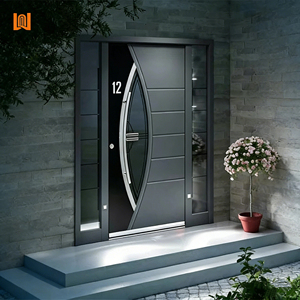
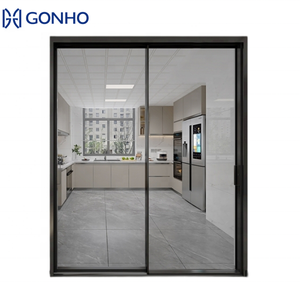
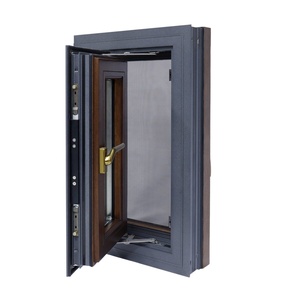
Direct Foshan Manufacturing Park

China Best Aluminium Glazed Window Manufacturers & Exporter

Engineered Fenestration Systems, Precision Thermal-Break Extrusions, Hurricane-Resistant IGUs & Global Project Export Solutions

Architectural Showcase

Featured Aluminium Glazed Windows & Commercial Systems

Discover high-performance fenestration solutions tested to Australian AS2047 N6, American NFRC, European CE EN 14351-1, and UL fire standards. Engineered for coastal weather tightness, seismic structural stability, and superior thermal acoustic insulation.

Aerial view of Guangdong Dejiyoupin Doors and Windows Co., Ltd. Foshan production base
Manufacturer Credibility • E-E-A-T Authority

Direct Manufacturer: Guangdong Dejiyoupin Doors and Windows Co., Ltd. (DERCHI)

Headquartered in Foshan, Guangdong—the world’s premier architectural aluminum processing capital—Guangdong Dejiyoupin Doors and Windows Co., Ltd. (DERCHI) operates as a globally ranked fenestration specialist with over 25 years of engineering precision. Our integrated facility spans over 180,000 square meters of automated fabrication workshops, robotic extrusion processing lines, and certified quality-testing laboratories.

From custom curtain walls, slim-frame casement windows, and oversized hurricane-proof sliding systems to architectural entry doors, our comprehensive product portfolio provides end-to-end reliability for real estate developers, structural contractors, civil engineers, and overseas fenestration distributors.

  • ✓ Full In-House Engineering: Dedicated R&D team preparing structural wind-load calculations, thermal modeling (U-factor), and complimentary CAD/BIM shop drawings.
  • ✓ Rigorous International Testing: Products independently tested to Australia AS2047 N6 cyclonic standards, CE EN 14351-1, ISO 9001, and UL Fire Rating.
  • ✓ Global Logistics Hub: Direct proximity to South China maritime hubs (Guangzhou, Shenzhen, Hong Kong ports), ensuring safe container shipping and seaworthy crating.
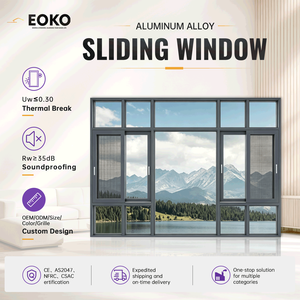
International fenestration certification logos
180,000㎡
Smart Production Facility
25+
Years Fenestration Craft
100+
Certifications & Patents
600+
Engineers & Technicians
Technical Engineering Whitepaper

Critical Specifications in Aluminium Glazed Window Engineering

Procuring architectural glazed windows from China requires an analytical evaluation of profile metallurgy, polyamide thermal barriers, insulated glass unit (IGU) gas retention, and dynamic air-water structural infiltration ratings.

Alloy Metallurgy: 6063-T5 vs. 6063-T6

We utilize primary A00 aluminium ingots extruded to wall thicknesses of 1.4mm to 2.0mm for residential windows, and 2.0mm to 3.0mm for high-span sliding systems. T6 artificial aging enhances yield strength beyond 170 MPa, resisting extreme positive and negative typhoon gusts without permanent frame deflection.

Thermal Break Chemistry: PA66 GF25

Cheap PVC or low-grade polyamide strips crack under solar thermal stress. We strictly specify technoform polyamide PA66 reinforced with 25% glass fiber. This guarantees coefficient matching with aluminum expansion, eliminating linear shear failure while dropping overall assembly Uw values down to 1.1 - 1.4 W/m²·K.

Gas-Filled Low-E IGU Formulations

Our dual- and triple-glazed units integrate double-silver (Low-E2) or triple-silver (Low-E3) soft vacuum magnetron sputter coatings. Filled with 90%+ Argon gas and sealed with dual-barrier polyisobutylene (PIB) plus structural silicone, they prevent condensation while filtering 99% of damaging UV rays.

Glazing Specification Configuration U-Value (W/m²·K) Solar Heat Gain (SHGC) Acoustic Sound Transmission (Rw) Recommended Architectural Application
Standard Non-Thermal 5+9A+5mm Clear 3.8 - 4.5 0.72 28 - 30 dB Interior office partitions, tropical non-conditioned spaces
Thermal Break 6+12Ar+6mm Double Low-E 1.6 - 1.9 0.35 - 0.42 35 - 38 dB Standard energy-efficient residential villas & hotels
Architectural 6Low-E+16Ar+6+1.52PVB+6 Laminated 1.3 - 1.5 0.28 - 0.32 42 - 46 dB Cyclone zones, coastal typhoon corridors, soundproof city centers
Passive House 5LowE+16Ar+5LowE+16Ar+5 Triple 0.8 - 1.1 0.22 - 0.28 45 - 48 dB Cold climate regions, net-zero buildings, LEED Platinum builds
Procurement Forecasting

Future B2B Procurement Trends for Commercial Fenestration

How international developers, architects, and volume importers are shifting their procurement strategies to balance sustainability, speed-to-market, and supply chain transparency.

01

Decarbonization & Low-Carbon Billet Sourcing

Global green building rating schemes (LEED, BREEAM, Green Star) now audit embodied carbon in fenestration. Procurement tenders increasingly demand Environmental Product Declarations (EPDs) and recycled scrap content in billet extrusion, rewarding factories with hydro-powered metallurgical supply chains.

02

Prefabricated Unitized Window & Wall Modules

Due to surging on-site construction labor costs in North America, Australia, and Europe, buyers are shifting from knock-down (KD) field assembly to pre-glazed, factory-calibrated unitized window cassettes with pre-fitted sub-sills and flashing fins, drastically shortening erection cycles.

03

BIM LOD300 Direct Digital Fabrication

Modern procurement bypasses manual 2D CAD handoffs. Specifiers mandate BIM (Building Information Modeling) objects at LOD300 or LOD400. Automated CNC five-axis milling centers directly ingest schedule coordinates, slashing production lead-times and eliminating on-site dimensional misfits.

Technology Horizon

Technological Innovations Reshaping Aluminium Glazing

Next-generation thermal, mechanical, and smart automation technologies engineered into modern architectural aluminum systems.

A

Vacuum Insulated Glazing (VIG) Integration

Replacing bulky triple glazing with ultra-thin (8-10mm) vacuum insulated panels. Featuring micro-spacer arrays with internal pressure lower than 0.1 Pa, VIG achieves center-of-glass Ug values of 0.4 W/m²·K while maintaining slim profile depths suitable for minimalist sightline windows.

B

Concealed Motorization & Smart Building Automation

Window frames now seamlessly host 24V brushless DC linear actuators, magnetic contact sensors, and motorized perimeter multipoint gearboxes. Connected through KNX, Zigbee, or BACnet protocols, windows auto-cycle for night purge cooling and close instantaneously upon rain-sensor detection.

C

Qualicoat Class 3 & Hyper-Durable PVDF Finishes

To resist 3,000+ hours of coastal neutral salt spray (ASTM B117), our factory applies fluorocarbon 3-coat/2-bake PVDF and Qualicoat Class 3 super-durable powder coatings, providing 20- to 30-year resistance against severe chalking, UV degradation, and maritime humidity corrosion.

Procurement Knowledge Base

Frequently Asked Questions by Global Importers & Specifiers

Direct, authoritative technical answers to common queries on international compliance, ocean-freight packaging, factory auditing, and warranty protocols.

How do DERCHI aluminium windows comply with Australian AS2047 and American NFRC testing standards? +
Our systems are tested by accredited third-party NATA (Australia) and NFRC-approved laboratories. Testing criteria include AS4420.2 / AS2047 deflection tests (Span/250 up to Serviceability Design Wind Pressure of 3000 Pa), air infiltration below 1.0 L/s·m² at 75 Pa, and water penetration resistance surpassing 600 Pa without leaking (N6 rating). For American projects, thermal testing adheres to NFRC 100/200/500 simulation modeling for U-factor, SHGC, and Visible Transmittance ratings.
How does your factory mitigate the risk of glass breakage and corner denting during long ocean transits? +
We implement a six-layer export protection protocol: (1) Anti-scratch electrostatic protective peel film applied on all profile faces; (2) Thick closed-cell foam edge-guards on all four sash corners; (3) Multi-layer stretch shrink film with moisture desiccant bags; (4) Fully enclosed non-fumigation plywood crates (certified ISPM 15); (5) Internal rubber shock cushions separating each frame; and (6) Steel-strapped container dunnage securing each crate against maritime harmonic resonance.
What is the standard manufacturing lead time for custom engineered commercial window schedules? +
Lead times are strictly phased: Standard finish (Matte Black, Traffic White, Grey RAL 7016) with standard double-glazed schedules takes 25 to 35 calendar days following CAD shop drawing approval. Custom extrusion dies or non-standard RAL fluorocarbon powder batches require an initial 10-14 days for die cutting and sample confirmation. Rush delivery options can be coordinated for milestone-driven commercial construction towers.
Can your technical engineering team provide CAD shop drawings and BIM structural calculations before deposit? +
Yes. Our in-house technical department of over 30 engineering draftsmen provides preliminary elevation schematics, structural wind load evaluations (Ixx values), and cross-sectional connection details for window head, jamb, and sill flashing based on your architectural drawings. Once commercial terms are aligned, full BIM LOD300 families and detailed shop drawings are generated for sign-off prior to CNC profile cutting.
How do you handle hardware durability and long-term warranty provisions for overseas installations? +
We partner with internationally recognized hardware suppliers including German Siegenia, Roto, Hoppe, and top-tier custom stainless steel systems. Hardware undergoes cycle testing up to 100,000 opening/closing operations without mechanical sag. We offer a 10-year structural frame warranty, a 5-year hardware replacement warranty, and 10-year seal failure warranty on all insulated glass units, with express courier dispatch for replacement components.

Ready to Engineer Your Project's Fenestration Schedule?

Submit your architectural elevations, door & window schedules, or custom structural specifications to our Foshan engineering division. Receive precise shop drawings, performance modeling data, and transparent factory-direct pricing within 24 business hours.

Inquire Now