Featured Fenestration & Entrance Systems
Explore our heavy-duty architectural aluminum swing doors, custom thermal-break frames, soundproof fenestration, and hurricane-rated exterior portals fabricated for institutional and luxury residential demands.
Architectural Aluminum Swing Doors: Structural Analysis & Recommendations
Modern fenestration demands exact tolerances, thermodynamic isolation, and structural integrity under dynamic wind load pressures. Our OEM/ODM aluminum swing door solutions are calibrated to strict architectural thresholds.
Heavy-Duty Exterior Swing Doors
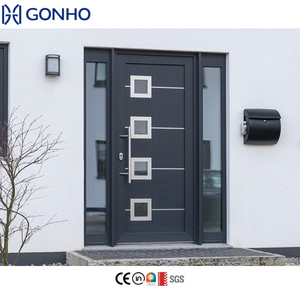
Engineered for high-traffic entryways and harsh coastal environments, these portals incorporate 6063-T6 or 6061-T6 architectural aluminum with a minimum wall thickness of 2.0mm to 3.0mm. Outfitted with heavy-duty 316 stainless steel friction-stay continuous hinges or concealed hydraulic pivots, our swing doors withstand up to 450 kg leaf loads while maintaining effortless tactile operation. Recommended for luxury villa main entries, high-end retail fronts, and corporate vestibules.
Thermal-Break High-Efficiency Systems
Designed to comply with rigorous passive house thermal limits and international ASHRAE standards, our thermal-break swing systems integrate polyamide PA66 GF25 insulation strips. This mechanical barrier prevents thermal bridging across the interior and exterior aluminum profiles, minimizing condensation and drastically lowering HVAC loads in extreme climates—from equatorial Southeast Asia humidity to sub-zero North American and European winter exposures.
Acoustic & Interlocking Security Doors
Urban density requires superior noise mitigation and forced-entry deterrence. Utilizing multi-point shoot-bolt locking mechanisms powered by German-engineered gearboxes and dual EPDM co-extruded foam gaskets, these swing doors deliver acoustic attenuation up to STC 42-45 dB when combined with double or triple-pane acoustic PVB laminated glass. Ideal for high-density condominium units, executive boardrooms, and luxury urban residences.
| Door Profile System | Alloy Grade & Wall Spec | Thermal & Acoustic Index | Wind-Pressure Resistance | Recommended Project Scope |
|---|---|---|---|---|
| Non-Thermal Architectural Swing | AlSiMg 6063-T5 (1.6mm - 2.0mm) | U-Value: 3.8 W/m²K | STC: 30 dB | Class 4 (ASTM E330 2000 Pa) | Interior partitions, mild coastal enclosures, commercial corridors |
| Thermal-Break Performance Swing | 6063-T6 + PA66 GF25 (2.0mm - 2.5mm) | U-Value: 1.4 - 1.8 W/m²K | STC: 38 dB | Class 5 (ASTM E330 3500 Pa) | Villas, high-rise balconies, institutional facades |
| Typhoon-Rated Structural Swing | 6061-T6 High Tensile (2.5mm - 3.2mm) | U-Value: 1.6 W/m²K | STC: 43 dB | AS 2047 N6 / TAS 201/202/203 Impact | Coastal estates, island resorts, tropical typhoon exposure belts |
| Cast Aluminum Art-Plate Hybrid | Cast Aluminum + 6063 Core (Up to 8.0mm plate) | U-Value: 1.9 W/m²K | STC: 45 dB | Exceeds 4500 Pa Structural Load | Flagship estate gates, luxury hotel main lobbies, security villas |
Future Sourcing & Procurement Trends (2025–2030)
Global architectural procurement is undergoing a paradigm shift. Specifiers, general contractors, and developers must evaluate structural lifecycle sustainability, digital supply chains, and evolving climate resilience benchmarks.
1. Direct-from-Source OEM/ODM Customization
Global developers are aggressively bypassing local middlemen in favor of Tier-1 Chinese manufacturers capable of end-to-end custom extrusion, CNC fabrication, and pre-glazed assembly. Procuring complete fenestration packages direct from Foshan-based automated manufacturing hubs reduces overall capital expenditure by 28% to 40% while allowing precise architectural shop-drawing revisions directly with in-house structural engineers.
2. Low-Carbon Aluminum & EPD Verifications
With stringent EU Carbon Border Adjustment Mechanism (CBAM) rollouts and global LEED v4.1 certifications, enterprise procurement officers are mandating Environmental Product Declarations (EPD). Modern aluminum swing door procurement requires prime smelted bauxite processed via renewable hydroelectric energy or scrap recycling loops, ensuring embodied carbon footprints drop below 4.0 kg CO2e per kg Al.
3. IoT Integration & Biometric Concealment
Traditional locksets are rapidly transforming into concealed smart-access ecosystems. Sourcing specifications across luxury developments now specify swing doors equipped with integrated brushless motor drives, recessed 3D facial recognition, mobile Bluetooth BLE credentials, and multi-sensor perimeter alarms discreetly engineered inside the extruded stile chambers without compromising structural frame inertia.
Technological & Manufacturing Development Trajectory
The manufacturing architecture of aluminum swing doors is moving from manual profile cutting toward high-precision digital twin modeling, robotic laser machining, and advanced surface nanotechnology.
Ultra-Narrow Bezel & Flush-Coplanar Profiles
Where conventional swing doors featured visible frame margins upwards of 80mm–110mm, next-generation systems employ high-strength metallurgical alloying to produce visible sightlines as slender as 38mm. Simultaneously, floor-to-ceiling coplanar sash-and-frame designs allow the swing door to sit perfectly flush with adjacent wall cladding, satisfying the modern minimalist design ethos championed by world-class architects.
Fluorocarbon (PVDF) & Ceramic Anodizing
Surface treatment has advanced far beyond standard electrostatic powder coating. State-of-the-art vertical continuous coating lines apply three-coat, two-bake Kynar 500 / Hylar 5000 PVDF fluorocarbon coatings or electrolytic micro-arc oxidation (MAO). These treatments deliver salt-spray resistance exceeding 4,000 hours (ASTM B117), providing total immunity against chalking, fading, and micro-cracking across hyper-saline island environments.
Automated CNC Corner Crimping & Corner-Cleat Injection
Air and water impermeability depends on joint precision. Modern factories employ CNC four-head hydraulic corner crimping machines paired with continuous twin-component structural polyurethane glue injection. This automated manufacturing protocol guarantees that every 45-degree mitered corner achieves micro-millimeter alignment, preventing sag, air infiltration, or water weeping under cyclical typhoon storms.
Why Global Importers & Contractors Partner With Us
Recognized as one of the premier door and window manufacturers based in Foshan, Guangdong, our enterprise combines immense production infrastructure with agile technical consulting and strict international quality standards.
180,000㎡ Mega Production Base
Operating one of Southern China's largest intelligent door manufacturing facilities, equipped with automated extrusion handling, multi-axis CNC machining, and comprehensive pre-assembly staging areas.
Global Code Compliances
Full compliance verification holding CE, ISO 9001, Australian AS 2047 N6 cyclonic testing, and UL fire-rated certifications ensuring turnkey regulatory approval across North America, Europe, Australia, and Asia.
100% CAD/BIM Shop Drawing Support
Our dedicated engineering department drafts free, bespoke CAD shop drawings and structural wind calculations for your specific project door schedule prior to batch fabrication, eliminating on-site dimensional errors.
Same-Time-Zone Engineering Support
Operating on GMT+8 alongside major commercial shipping corridors, our bilingual sales engineers provide real-time quote generation, VR factory walkthrough audits, and structured international export sea-packing.
Frequently Asked Questions: Sourcing Aluminum Swing Doors
Clear, authoritative technical answers addressing common procurement hurdles, testing requirements, hardware choices, and supply-chain logistics for B2B importers.
What aluminum alloy grade is optimal for commercial swing doors?
For architectural exterior swing doors, 6063-T6 is the industry standard due to its excellent surface finish capabilities, structural rigidity, and corrosion resistance. In high-wind, hurricane-impact, or blast-resistant scenarios, 6061-T6 is specified for its significantly higher tensile yield strength, ensuring frames resist deflection during severe positive and negative wind pressure cycles.
How do thermal-break swing doors mitigate HVAC operational expenses?
By inserting an engineered polyamide (PA66 GF25) thermal insulator between the inner and outer aluminum profiles, thermal conduction across the frame is reduced by up to 70%. When configured with low-E argon-filled insulating glass units (IGUs), overall system U-values drop below 1.6 W/m²K, translating to an estimated 18%–25% reduction in whole-building heating and cooling loads.
What certifications are mandatory for exporting swing doors to the West & Australia?
In Australia, doors must meet AS 2047 (covering structural deflection, air leakage, and water penetration) and AS 1288 (safety glazing). In North America, testing revolves around AAMA/WDMA/CSA 101/I.S.2/A440 (NAFS) and NFRC thermal performance ratings. In the European Union, CE marking following EN 14351-1 is legally required. Our facility routinely manufactures and certifies profiles compliant with all four systems.
How are oversized aluminum swing doors secured against sagging?
Preventing sash sag in oversized doors (heights > 3.0m or weights > 250 kg) requires three structural methods: heavy-gauge internal corner brackets secured with pinned mechanical locks, diagonal "toe-and-heel" glass shimming that leverages the IGU's rigidity as a structural truss, and multi-point 3D adjustable 316 stainless steel ball-bearing hinges fastened directly into the profile's internal structural webbing.
What is the standard production lead time and export packaging standard?
Standard OEM/ODM fabrication requires 25 to 35 days following client approval of CAD shop drawings. For international maritime transit, doors undergo five-stage protective packaging: protective surface PE tape, non-woven protective wrap, custom EPE foam edge cushions, and crating inside fumigated ISPM-15 compliant sea-freight plywood cases designed for containerized forklift offloading.
Can your manufacturing lines integrate third-party access control hardware?
Yes. We offer fully customized CNC hardware prep routings to fit major global locking hardware systems—including mortise locks from Dormakaba, ASSA ABLOY, Schlage, or German GU. Our engineering team directly matches your architectural hardware schedules to prepare precise factory drop-ins, concealed wire transfer conduits, and motorized strike pockets prior to profile surface coating.