Architectural Fenestration White Paper

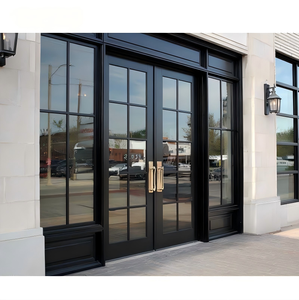
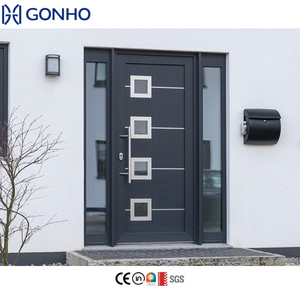
Top China Aluminium Crittall Style External Doors Manufacturers & Factory

Engineered Industrial Steel-Look Heritage Aesthetics with Multi-Cavity Polyamide Thermal Barriers, Cyclonic Wind Load Ratings & Factory-Direct Precision Manufacturing

Engineered Collections

Featured Industrial & Crittall-Inspired Architectural Systems

Explore precision-extruded 6063-T6 aluminium external assemblies, acoustic French multi-light grids, heavy-duty panoramic bifolding systems, and hurricane-certified commercial portals.
Engineering White Paper

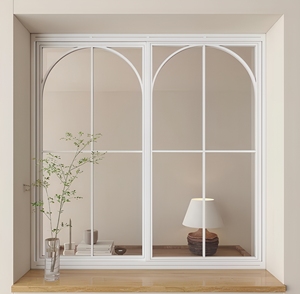
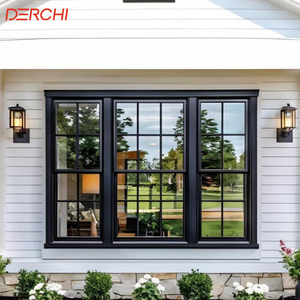
The Renaissance of Crittall-Style External Portals: Steel Legacy vs. Thermally Broken Aluminium

Originally pioneered in the late 19th century by Francis Berrington Crittall in Essex, the steel-framed fenestration paradigm redefined modern industrial architecture, establishing an enduring visual vernacular characterized by slim sightlines, geometric multi-pane grids, and uncompromised structural definition. However, in 21st-century exterior envelope engineering, traditional hot-rolled mild steel presents formidable physical challenges: excessive thermal transmittance (leading to severe interior condensation and energy penalties), high vulnerability to galvanic and atmospheric corrosion in coastal or high-humidity regions, and massive weight burdens requiring reinforced structural lintels.

As architectural firms, façade engineers, and luxury residential builders look to China's advanced manufacturing clusters in Foshan, Guangdong, the definitive technological evolution is the Thermally Broken Aluminium Crittall-Style External Door System. By leveraging architectural-grade 6063-T6 or 6005A-T6 aerospace-grade aluminium alloy profiles coupled with polyamide (PA66 GF25) thermal insulation struts, modern manufacturers reproduce the iconic razor-thin 28mm to 35mm sightlines of traditional hot-rolled steel while delivering full compliance with modern energy codes, including ASHRAE 90.1, Title 24, and European EN 14351-1 standards.

Engineering Comparison: Traditional Steel vs. Thermally Broken Aluminium Crittall Systems

Validated Factory Test Standards
Performance Parameter Traditional Hot-Rolled Mild Steel Standard Non-Thermal Aluminium DERCHI Thermally Broken Aluminium Crittall
U-Factor (Thermal Insulation) 4.5 - 5.8 W/m²·K (Severe condensation risks) 3.8 - 4.6 W/m²·K (Poor energy rating) 1.1 - 1.6 W/m²·K Passive House Ready
Atmospheric Corrosion Resistance Requires constant painting; rusts at weld points Fair; subject to pitting without treatment Qualicoat Class 2 / PVDF 3-Coat C5-M Coastal Resilient
Structural Weight & Foundation Load Extremely heavy (~75-90 kg/m²); high hinge strain Lightweight (~20-25 kg/m²); lower rigidity Optimized Structural (~32-45 kg/m²) Balanced Ergonomics
Wind Load Resistance (AS 2047 / ASTM E330) Very high structural modulus, but rigid deflection Moderate; prone to wind whistle under suction AS 2047 N6 (Design Pressure >4500 Pa) Typhoon Certified
Glazing Flexibility & Acoustic STC Single glazing or thin double units (STC 26-30 dB) Double glazed up to 24mm (STC 30-34 dB) Triple Insulated Low-E / Laminated (STC 38-46 dB)
Total Cost of Ownership (15-Year Life Cycle) High acquisition + steep recurring rust maintenance Low initial cost; high long-term HVAC costs Lowest Total Cost (Zero corrosion + 40% HVAC savings)
Technical Architecture

Technological Innovations Driving Chinese Aluminium Crittall Manufacturing

Discover the micro-engineering breakthroughs that allow slender aluminium sections to achieve hurricane wind-load resistance, acoustic silence, and airtight perimeter seals.

Multi-Cavity Polyamide Thermal Barriers

Utilizing precision-crimped PA66 GF25 (25% fiberglass reinforced) thermal struts with multi-cavity chambers eliminates the thermal bridge between exterior cold/heat and interior ambient temperature. Integrated low-emissivity air chambers achieve thermal breaks exceeding 34mm, completely arresting interior condensation.

Authentic Astragal Bar Engineering

To avoid the structural weakness of true divided lites while preserving vintage industrial character, our factory implements structural astragal bars. CNC-milled exterior and interior aluminium muntin grids are mechanically locked with internal duplex spacer bars inside the insulated glass unit (IGU), creating authentic shadowlines.

Continuous EPDM Perimeter Gasketing

Traditional steel french doors frequently suffer from draft leaks. Our aluminium external assemblies deploy continuous co-extruded cellular EPDM vulcanized gasket loops with precision corner-welded joints, achieving Class 4 Air Permeability (EN 12207) and watertightness up to 1200 Pa under cyclic water testing.

Qualicoat Class 2 & Fluorocarbon PVDF

Engineered specifically for harsh coastal, high-UV, and monsoon-exposed regions. Profile surfaces receive multi-stage chemical pretreatment followed by architectural powder coating (AkzoNobel / Tiger Drylac) or 70% Kynar 500 PVDF fluorocarbon coatings, certified to pass 3,000-hour accelerated acetic acid salt spray tests.

Concealed Multi-Point Security Locking

Security is seamlessly integrated without disturbing the minimalist industrial profile. Concealed European groove hardware systems incorporate hardened steel shoot-bolts, anti-lift pins, and multi-point deadbolts tested to EN 1627 RC2/RC3 burglar resistance and UL 10C security standards.

Structural Corner Joint Mechanics

Unlike welded mild steel frames that can warp and require extensive grinding, our precision extrusions are joined using heavy-duty cast aluminium corner brackets injected with German two-component polyurethane bonding adhesives. This ensures microscopic 0.05mm joint tolerance and lifelong structural squareness.

Market Intelligence

Future Procurement Trends for Architectural External Glazing (2025–2030)

How international developers, general contractors, and facade consultants are streamlining door procurement from tier-1 Chinese manufacturing ecosystems.

Low-Carbon Recycled Billets

Global procurement mandates now require Environmental Product Declarations (EPD). Chinese smelters and extruders increasingly deploy hydro-powered smelting and >75% recycled scrap aluminium, slashing embodied carbon from 18 kg CO₂/kg to under 4.2 kg CO₂/kg.

BIM & Modular Off-Site Integration

Commercial architects demand LOD 350 to LOD 400 BIM models directly from factory R&D teams. Doors are pre-glazed, factory-assembled, and delivered with sub-frame receivers for lightning-fast dry-installation on steel and concrete structures.

Smart Portals & Home Automation

The next frontier fuses heritage aesthetics with invisible smart access: motorized concealed automatic swing operators, biometric touch sensors integrated into pull handles, and magnet-switch sensors connecting to smart building management systems (BMS).

Direct Factory Value Engineering

By eliminating western domestic distributor markups (frequently inflating costs by 200–350%), Tier-1 procurement teams work directly with certified Foshan manufacturers, capturing substantial cost savings while maintaining AS 2047 and CE testing provenance.

Cross-border procurement data indicates that developers and building syndicates in Australia, the United States, Canada, the United Kingdom, and the Middle East are shifting toward holistic exterior envelope packages. Instead of sourcing windows, pivot portals, crittall external French doors, and bifold units from multiple decentralized workshops, sourcing from a consolidated 180,000㎡ industrial manufacturing hub guarantees consistent powder-coat batch coloration, identical glass tint spectroradiometry, and synchronized shipping container logistics.

Factory Authority & Scale

Enterprise Manufacturing Benchmark: Guangdong Dejiyoupin Doors and Windows Co., Ltd.

Operating from the global fenestration epicenter in Foshan, China, DERCHI stands as an elite manufacturer certified for high-end residential, hotel lobby, and typhoon-zone commercial applications.

180,000㎡
Smart Production Base
600+
Skilled Craftspeople & Engineers
100+
Patents & Global Certifications
25+
Years Industry Provenance

Rigorous 5-Stage Export Quality Control Matrix

Every crittall exterior door undergoes systematic metallurgical, dimensional, and pneumatic validation before crating.

01
Spectrometry & Extrusion
Alloy composition testing (6063-T6 hardness >12 Webster) and anodizing layer thickness gauge analysis.
02
CNC Miter Precision
German 5-axis digital cutting centers calibrate profiles within 0.1mm tolerance for airtight corner joints.
03
Dry Assembly & Fitting
100% pre-hanging of leaf panels, heavy-duty 3D adjustable hinges, and multi-point perimeter lock alignments.
04
Chamber Pressure Test
Batch testing under ASTM E331 water penetration (up to 1200 Pa) and ASTM E283 air infiltration parameters.
05
ISPM-15 Plywood Crating
Multi-layer protective film, custom high-density corner foam, and fumigation-free marine timber crates.
Third-Party Accreditations & Testing Reports CE (EN 14351-1) · ISO 9001:2015 · Australian AS 2047 (N6 Cyclone Tested) · UL 10C Fire Rated Portals
Buyer Knowledge Base

Frequently Asked Questions for International Buyers & Specifiers

Clear, technically precise answers addressing engineering tolerances, energy codes, hurricane compliance, freight logistics, and custom architectural sizing.

1. How do aluminium Crittall-style external doors prevent thermal bridging and interior condensation? +
Unlike historic rolled-steel doors which conduct thermal energy rapidly (resulting in cold inner frames and winter water puddling), our external aluminium Crittall systems utilize an engineered thermal break. We mechanically roll a high-performance polyamide strip (PA66 with 25% glass fiber reinforcement) between the interior and exterior aluminium profile extrusions. This creates a non-conductive barrier that disrupts energy transfer. When paired with double or triple-glazed Low-E argon-filled units with warm-edge spacers, overall thermal performance drops to U-values between 1.1 and 1.6 W/m²·K (0.20 to 0.28 BTU/hr·ft²·°F), satisfying cold-climate building codes in North America, Northern Europe, and Australasia.
2. What is the difference between "True Divided Lites" (TDL) and "Simulated Divided Lites" (SDL) in Crittall external applications? +
True Divided Lites (TDL) utilize separate, individual panes of glass inserted into distinct profile openings. While traditional, TDL creates dozens of independent perimeter seals, dramatically increasing potential water penetration points, compromising thermal U-factors, and elevating glass replacement costs. Our factory specializes in Simulated Divided Lites (SDL) with authentic internal duplex bars: a continuous, highly hermetic double- or triple-glazed IGU is manufactured, and precision CNC-milled aluminium astragal grid bars are bonded to both the exterior and interior glass surfaces using structural 3M VHB bonding systems. An anodized duplex shadow bar sits inside the sealed glass cavity directly behind the external bars, creating an architecturally indistinguishable aesthetic with superior thermal and airtight integrity.
3. How do these doors withstand coastal typhoons, cyclonic winds, and salt spray corrosion? +
DERCHI products are engineered and tested to Australia's AS 2047 standard, achieving the maximum N6 cyclonic rating with extreme design wind pressures exceeding 4,500 Pa (equivalent to Category 5 hurricane-force winds). For coastal marine environments (ISO 12944 C5-M high salinity), we apply Qualicoat Class 2 hyper-durable thermoset powder coatings or 3-coat 70% Kynar 500 fluorocarbon (PVDF) finishes that withstand over 3,000 hours of continuous acetic salt spray without blistering or fading. All hinge pins, internal multi-point linkages, and installation fasteners are manufactured from 304 or marine-grade 316 stainless steel to ensure zero galvanic corrosion.
4. What glass specifications are recommended for optimal solar control, acoustics, and impact safety? +
Depending on project geographic orientation, we configure customized architectural glass makeups:
  • Thermal & Solar Control: 6mm Low-E Tempered + 12A/16A Argon Cavity + 6mm Clear Tempered (Solar Heat Gain Coefficient / SHGC 0.22 - 0.38).
  • Acoustic Attenuation (Traffic / City): 6mm Tempered + 12A + 4mm + 0.76mm PVB Acoustic Interlayer + 4mm Laminated Glass, delivering Sound Transmission Class ratings up to STC 42-45 dB.
  • Hurricane Impact Resistance: 6mm Heat-Strengthened + 12A + 6mm + 1.52mm SentryGlas (SGP) ionoplast interlayer + 6mm Heat-Strengthened glass, certified to pass ASTM E1886/E1996 missile impact and cyclic pressure protocols.
5. Can the factory accommodate oversized portal openings, pivot hinges, or custom French double leaf designs? +
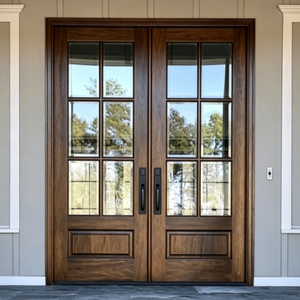
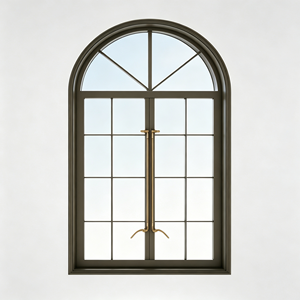
Yes, 100% of our production is made-to-order according to architectural schedules. We regularly engineer oversized single-leaf external pivot doors up to 2.2 meters (7.2 ft) in width and 4.5 meters (14.7 ft) in height, utilizing German FritsJurgens or dormakaba concealed heavy-duty hydraulic floor pivots rated for up to 500 kg leaf weights. For external Crittall French doors, we provide matched fixed transom lites, arched fanlights, side-lights, and integrated flush-threshold drainage channels designed for zero-barrier indoor-outdoor transitions.
6. What is the standard technical drawing review and engineering sign-off process before manufacturing? +
Prior to cutting any aluminium extrusion, our dedicated engineering division produces comprehensive CAD shop drawings and 3D cross-sectional elevations detailing exact rough opening (RO) clearances, wall interface flashing details, glass build-up, swing handedness, threshold drainage channels, and handle heights. Production only commences once the client's project architect, general contractor, or procurement manager formally reviews and signs off on the shop drawing submittal package.
7. How does DERCHI ensure export goods arrive undamaged and ready for jobsite installation? +
Export logistics require aerospace-grade packaging discipline. Finished frames and door leaves are wrapped in protective polyethylene scratch films, encased in shock-absorbing EPE closed-cell corner foam, and packed inside heavy-duty, fumigation-free ISPM-15 compliant plywood crates. For full container loads (20GP, 40HQ), crates are engineered with structural lifting lugs and secured to container anchor rings with heavy-duty ratchet tie-downs and inflatable dunnage bags to eliminate transit shifting during transoceanic voyages.
8. What is the typical factory lead time and FOB/CIF shipping duration from Foshan to international ports? +
Standard manufacturing lead time ranges from 25 to 35 calendar days following shop drawing sign-off and color chip approval. Foshan's strategic proximity to major Pearl River Delta ocean ports (Nansha, Shekou, and Yantian) facilitates seamless maritime departures:
  • Southeast Asia (Manila, Singapore, Port Klang, Bangkok): 4 to 8 ocean transit days.
  • Australia (Sydney, Melbourne, Brisbane): 12 to 18 ocean transit days.
  • Middle East (Jebel Ali, Dammam, Doha): 15 to 22 ocean transit days.
  • North America West Coast (Long Beach, Vancouver): 14 to 20 ocean transit days.
  • Europe (Rotterdam, Hamburg, Felixstowe): 28 to 36 ocean transit days.
9. How does the factory handle warranty coverage and spare parts replacement for international projects? +
We provide a 10-year comprehensive factory warranty on aluminium profile extrusion structural integrity and Qualicoat/PVDF surface finish durability, along with a 5-year warranty on insulated glass units and European hardware mechanisms. In every commercial export shipment, we include a 3% complimentary jobsite spare parts kit containing matching EPDM gaskets, astragal bar corner splices, hardware fasteners, and touch-up paint pens. In the rare event of transit damage, replacement parts or glass units are expedited via air freight within 72 hours.
10. Can commercial specifiers schedule virtual factory inspections or third-party audits (SGS / Intertek)? +
Absolutely. We welcome both on-site factory visits to our 180,000㎡ industrial park in Shishan Town, Foshan, as well as scheduled 360-degree interactive VR factory tours and live high-definition video inspections. Furthermore, we routinely coordinate with international inspection bodies such as SGS, TÜV Rheinland, Intertek, and Bureau Veritas for raw material witnessing, dry-fit dimension verification, and container loading supervision.

Ready to Engineer Your Architectural Exterior Entrance?

Send your door schedules, CAD elevations, or project BOQ to our English-speaking engineering team on GMT+8. Receive customized shop drawings, thermal calculations, and competitive factory-direct CIF quotes within 24 hours.